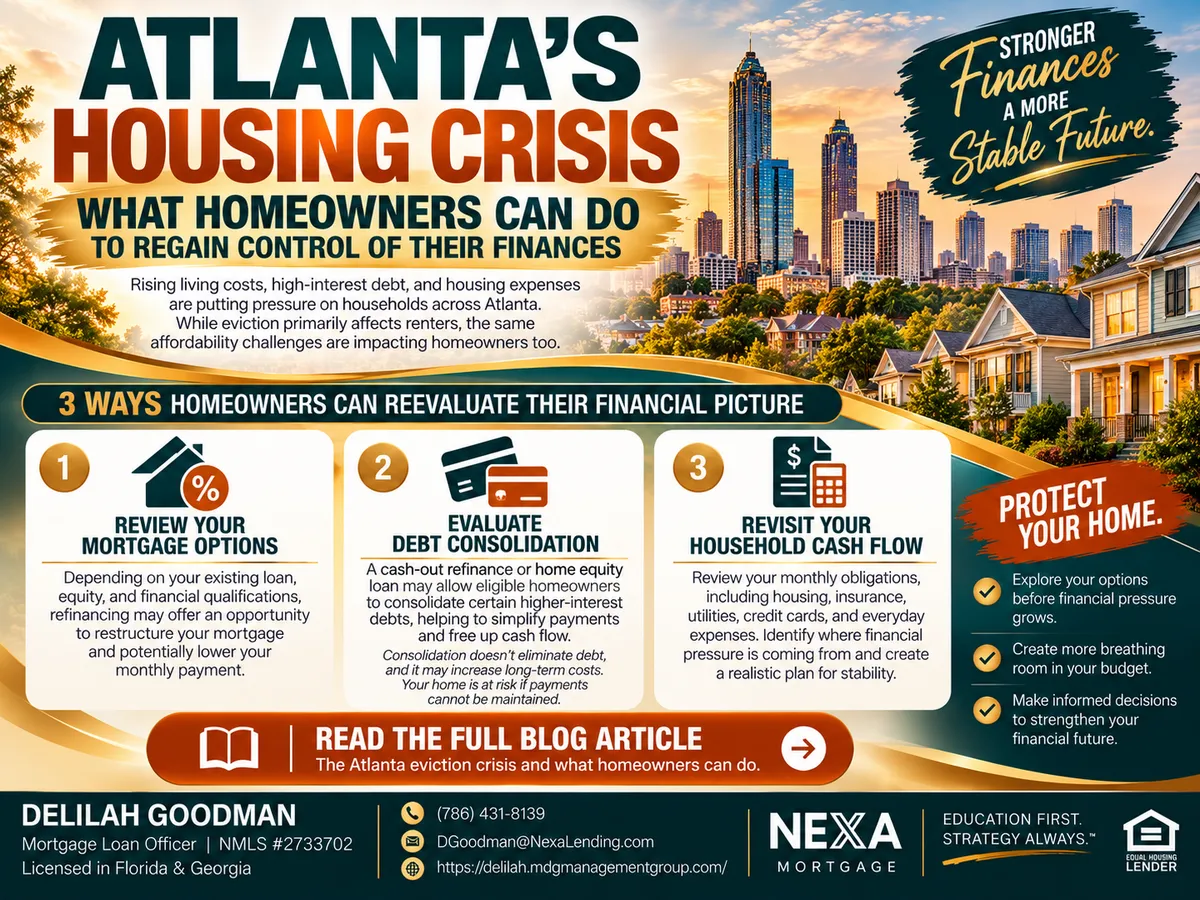
Atlanta's Eviction Crisis: What Homeowners Can Do to Protect Their Financial Stability
Atlanta's Eviction Crisis: What Homeowners Can Do to Protect Their Financial Stability
Atlanta is facing a serious housing affordability challenge, and the latest eviction data should get everyone's attention.
According to the Atlanta Regional Commission, 142,047 eviction filings were recorded across five core metro Atlanta counties between June 2025 and May 2026.
That's a filing rate of approximately 24% relative to renter households.
Now, an eviction filing doesn't automatically mean someone was physically removed from their home. The data also show a longstanding problem rather than a sudden new surge.
But the message is clear: housing stability deserves serious attention.
And while eviction primarily affects renters, homeowners face their own financial pressures—including the risk of foreclosure when mortgage obligations become unmanageable.
So let's talk about what homeowners can do before financial pressure becomes a housing emergency.
1. Evaluate Your Household Debt
Credit cards, personal loans, vehicle payments, insurance, groceries, and utilities can place significant pressure on a household budget.
Start by identifying which obligations carry the highest interest rates, which payments consume the most monthly income, and whether your existing repayment structure is sustainable.
Sometimes the challenge isn't simply how much you owe. It's how those obligations affect your monthly cash flow.
2. Explore Whether Refinancing Makes Financial Sense
For some homeowners, refinancing may provide an opportunity to restructure existing mortgage debt.
Depending on available equity, credit, income, current mortgage terms, and eligibility, options may include:
A traditional mortgage refinance.
A cash-out refinance to consolidate certain higher-interest debts.
A home equity loan or HELOC, where appropriate.
But refinancing isn't automatically a savings strategy.
Replacing a low-rate mortgage with a higher-rate loan, extending the repayment term, or using home equity to pay unsecured debt can increase total borrowing costs and put your home at greater risk.
The objective should be to compare the complete financial outcome—not simply obtain a lower monthly payment.
3. Understand the Difference Between Debt Relief and Debt Elimination
Here's an important distinction.
Consolidating debt doesn't necessarily eliminate debt. It restructures how you repay it.
A cash-out refinance might allow a homeowner to pay off several existing obligations, but those balances become part of a mortgage secured by the home.
That could improve monthly cash flow in some situations while increasing long-term interest expense.
This is why I believe every homeowner deserves an individualized analysis before using home equity.
4. Don't Wait Until You're Behind on Your Mortgage
If your household expenses are becoming difficult to manage, begin reviewing your options early.
Contact your mortgage servicer if you're struggling with payments. Ask about available assistance or loss-mitigation options.
A HUD-approved housing counselor may also help you understand foreclosure-prevention resources.
And if you're considering refinancing, review the costs, qualifications, repayment terms, and potential risks before proceeding.
5. Make Your Home Equity Part of a Financial Plan
Your home may represent one of your largest financial assets.
That equity deserves careful consideration.
Before using it to consolidate debt, ask whether the proposed financing would genuinely improve your financial position or simply move short-term obligations into a longer-term loan.
The goal isn't just to free up money this month. It's to protect your financial stability for the years ahead.
Let's Review Your Options
If you're a homeowner in Georgia or Florida and rising household expenses are putting pressure on your budget, let's discuss whether your current mortgage structure deserves a second look.
A refinance may be appropriate. Another solution may be better.
The important thing is making that decision with accurate information.
📩 Message me HOME to request a mortgage and household debt review.
Delilah Goodman
Mortgage Loan Officer | NMLS #2733702
Licensed in Florida & Georgia
Phone: (786) 431-8139
Email: [email protected]
Website: https://delilah.mdgmanagementgroup.com/
Education First. Strategy Always.™
Educational information only. Refinancing and home equity borrowing are subject to eligibility, underwriting, costs, and approval. Consolidating unsecured debt into a mortgage places your home at risk if you cannot repay.
Sources
Atlanta Regional Commission, October 9, 2026: https://atlantaregional.org/news/33n/latest-data-on-evictions-in-atlantas-5-county-core/
Princeton Eviction Lab, Atlanta Eviction Tracking System: https://dev.evictionlab.org/eviction-tracking/atlanta-ga/
Consumer Financial Protection Bureau, Debt Consolidation: https://www.consumerfinance.gov/ask-cfpb/what-do-i-need-to-know-if-im-thinking-about-consolidating-my-credit-card-debt-en-1861/