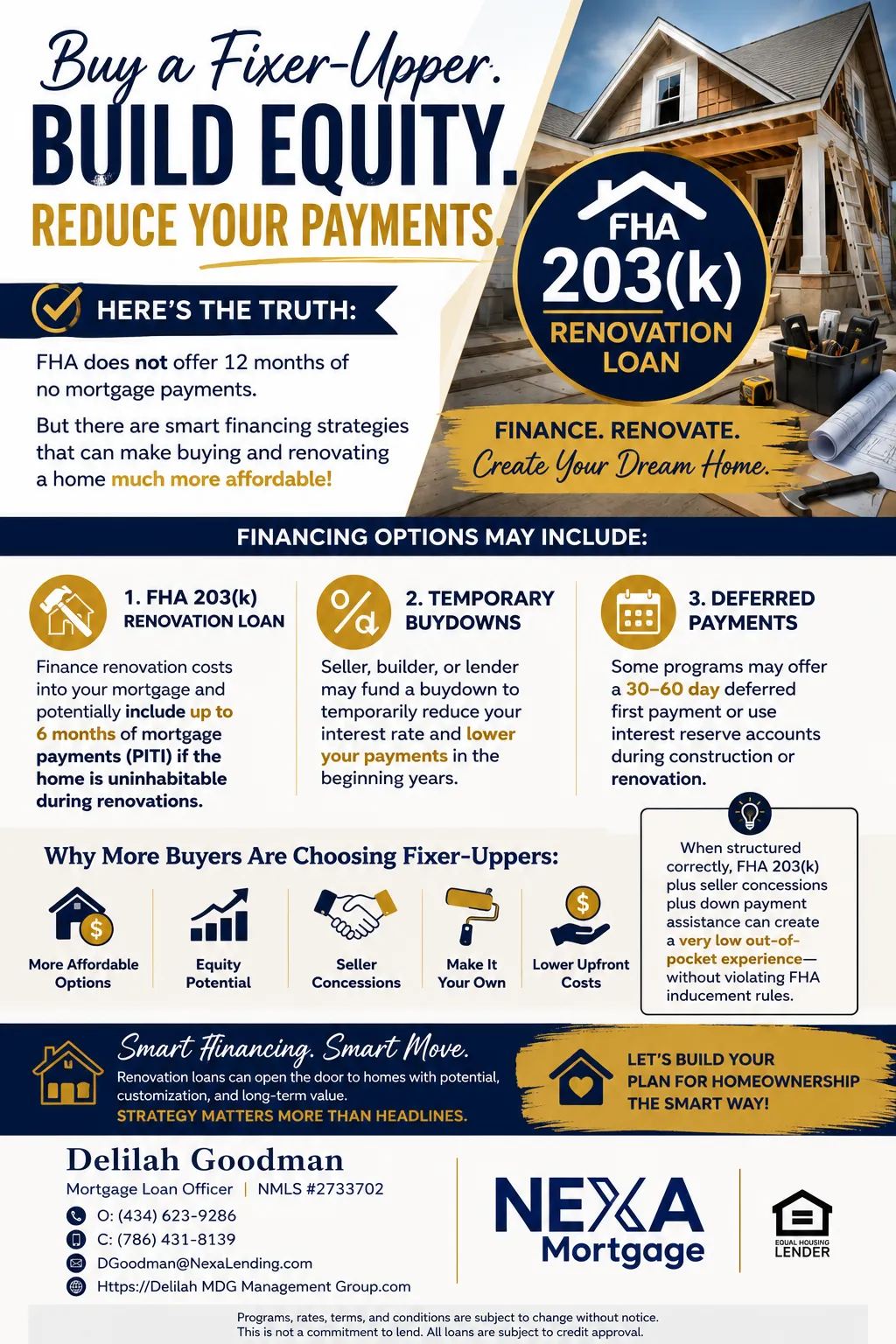
Can You Really Buy a Fixer-Upper and Skip Mortgage Payments for a Year?
Can You Really Buy a Fixer-Upper and Skip Mortgage Payments for a Year?
If you’ve spent any time on social media lately, you’ve probably seen headlines like:
“Buy a fixer-upper and don’t make mortgage payments for 12 months!”
At first glance, that sounds incredible.
And naturally, many homebuyers are asking:
“Did FHA create a new program that lets buyers live payment-free for a year while renovating a home?”
The short answer is:
No — not exactly.
But there are legitimate financing strategies that can make buying and renovating a home much more affordable than many buyers realize.
And in today’s market, that matters more than ever.
Why Buyers Are Suddenly Talking About Fixer-Uppers Again
Over the last few years, many buyers have struggled with:
Higher home prices
Limited inventory
Rising insurance costs
Competition for fully renovated homes
Affordability concerns
As a result, more buyers are beginning to look at homes that need cosmetic updates or repairs.
That’s where renovation financing enters the conversation.
Programs like the FHA 203(k) loan allow eligible buyers to purchase a home and finance renovation costs into a single mortgage.
Instead of needing separate loans for the purchase and repairs, buyers may be able to combine everything into one financing structure.
And when layered correctly with seller concessions, temporary buydowns, and down payment assistance, the overall upfront cost can sometimes become surprisingly manageable.
So… Where Did the “12 Months No Payments” Story Come From?
This is where the confusion begins.
FHA did not create a blanket program where borrowers automatically avoid mortgage payments for an entire year.
What many people are actually hearing about is a combination of several different strategies being used together.
These can include:
FHA 203(k) renovation financing
Seller-paid concessions
Temporary interest rate buydowns
Escrowed mortgage payments during construction
Deferred first payment structures
Down payment assistance programs
When these pieces are marketed together, it can sometimes sound like:
“You won’t have a mortgage payment for a year.”
But operationally, the reality is more nuanced.
Understanding the FHA 203(k) Renovation Loan
The FHA 203(k) loan is designed for buyers who want to purchase a property that needs repairs, updates, or rehabilitation.
This program allows eligible borrowers to:
Purchase a home needing renovations
Finance approved repair costs into the mortgage
Potentially improve the property’s value over time
Use FHA’s more flexible qualification structure compared to some conventional financing
For many first-time buyers, this creates opportunities in neighborhoods or price ranges that may otherwise feel out of reach.
The Part Most Buyers Don’t Know About
One feature of the FHA 203(k) program has existed for years:
If the property is temporarily uninhabitable during renovations, borrowers may be able to finance a limited number of mortgage payments into the renovation escrow.
Typically, this may allow for:
Up to 6 months of PITI
(Principal, Interest, Taxes, and Insurance)
But there are important conditions:
The home must genuinely be unlivable during renovations
The delay must be tied to construction timelines
The payments are not “free”
The cost is financed into the loan structure
This is a major distinction.
The borrower is still responsible for the cost — it’s simply being structured differently within the financing.
What Are Temporary Buydowns?
Another reason buyers are hearing these aggressive marketing messages is because temporary buydowns have become increasingly common.
A temporary buydown reduces the borrower’s interest rate for the first few years of the mortgage.
For example:
A 2-1 Buydown May Look Like This:
Year 1 → Rate reduced by 2%
Year 2 → Rate reduced by 1%
Year 3 onward → Full note rate begins
This means the borrower still makes payments — but the early payments are temporarily lower.
In many cases:
Sellers
Builders
Or lenders
may contribute funds toward these buydown structures as part of negotiations or incentives.
Deferred First Payments: Another Source of Confusion
Some renovation or construction lenders also structure loans with:
30–60 day delayed first payments
Interest reserve accounts
Draw-period financing structures
Again, these are not “free mortgage payments.”
They are financing tools designed to help manage cash flow during construction or renovation periods.
Why FHA Compliance Matters
One of the most important things borrowers should understand is that FHA closely regulates:
Seller incentives
Interested-party contributions
Artificial qualification manipulation
Inducements to purchase
That means lenders must be careful about how these programs are structured and advertised.
If you see marketing that sounds too good to be true, it’s important to ask:
Is this a temporary buydown?
Is it down payment assistance?
Is it escrowed mortgage payments?
Is it an interest reserve?
Are payments simply being rolled into the principal balance?
These are very different financing strategies from an underwriting and compliance standpoint.
And understanding the difference protects buyers from confusion later.
Why Fixer-Uppers Are Becoming Attractive Again
In many parts of Florida and across the country, older homes are becoming a major opportunity.
Why?
Because many sellers are now more willing to negotiate.
Buyers are finding opportunities where:
Inventory has become stale
Cosmetic rehab is needed
Sellers are motivated
Fully updated homes are priced significantly higher
For the right buyer, a fixer-upper can create:
✅ Lower purchase price potential
✅ Less competition
✅ More negotiation leverage
✅ Long-term equity opportunities
✅ Personalization and customization
Instead of competing for the most updated home on the market, some buyers are realizing they may be able to create value over time.
The Real Strategic Advantage
The true benefit of renovation financing is not “free mortgage payments.”
The real advantage is flexibility.
When structured correctly, buyers may be able to combine:
Renovation financing
Seller concessions
Down payment assistance
Temporary buydowns
into a strategy that lowers upfront cash requirements and improves affordability during the early years of ownership.
That’s why education matters.
Because the structure of the financing can dramatically impact:
Monthly payment
Cash to close
Approval strength
Long-term affordability
Future equity position
Delilah's Thought's
Headlines often simplify complex mortgage strategies into catchy marketing phrases.
But smart homebuyers should always understand how a loan actually works before moving forward.
Programs like FHA 203(k) renovation financing can absolutely create opportunities for buyers who want to:
Purchase homes with potential
Improve affordability
Build equity over time
Enter competitive markets more strategically
The key is making sure the loan is structured properly from the beginning.
Because in today’s market:
Strategy matters more than headlines.
Want to Explore Renovation Loan Options?
If you’re considering purchasing a fixer-upper, renovating a home, or learning what financing strategies may fit your goals, I’d be happy to help guide you through the options available.
Delilah Goodman
Mortgage Loan Officer | NMLS #2733702
O: (434) 623-9286
C: (786) 431-8139
[email protected]
Education first. Strategy always.