FHA Late Mortgage Protections
FHA Late Mortgage Protections Changed in 2026: What Homeowners Need to Know
Updated July 29, 2026
If you have an FHA mortgage and are behind on your payments, there are important servicing and foreclosure-prevention changes you should understand.
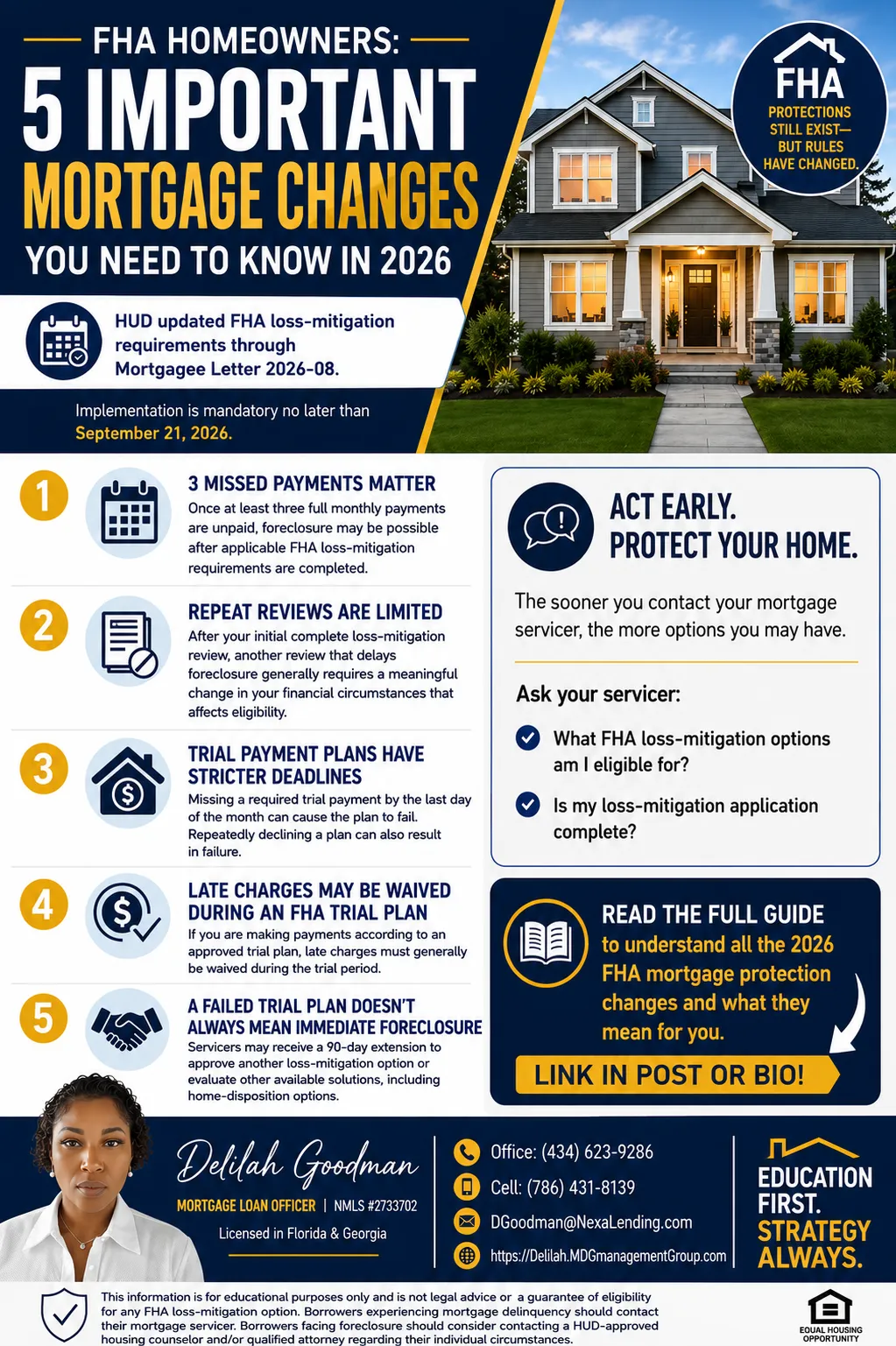
HUD updated FHA loss-mitigation requirements through Mortgagee Letter 2026-08, issued June 23, 2026. The changes affect how mortgage servicers handle delinquent FHA loans, repeat loss-mitigation requests, Trial Payment Plans, and when foreclosure may begin.
Servicers may already use the new requirements, and implementation becomes mandatory no later than September 21, 2026.
Three Missed Payments Matter More Under the Updated Rules
Once at least three full monthly mortgage payments are due and unpaid, an FHA servicer may be able to initiate foreclosure after completing applicable loss-mitigation requirements.
This does not mean foreclosure automatically begins after three missed payments.
The servicer may still have to complete required borrower outreach, loss-mitigation review, notices, appeal procedures, and other applicable federal and state requirements.
However, homeowners should take a 90-day delinquency very seriously.
Repeat Loss-Mitigation Reviews Are More Limited
One of the most significant changes involves borrowers who submit multiple requests for mortgage assistance.
After an initial complete loss-mitigation review, a later review that delays foreclosure generally must involve a change in the borrower's circumstances that affects eligibility.
This means borrowers should not assume they can repeatedly submit the same information and automatically restart the foreclosure-prevention process.
Your first complete loss-mitigation application matters.
Make sure requested income, hardship, employment, bank, and household documentation is submitted accurately and on time.
FHA Trial Payment Plans Have Updated Requirements
A Trial Payment Plan, or TPP, is often required before certain permanent FHA home-retention options are finalized.
Many borrowers will complete a three-month Trial Payment Plan, although longer periods may apply in certain situations.
Under the updated requirements, a TPP may be considered failed if a scheduled payment is not made by the last day of the month in which it is due.
Repeatedly failing to accept a TPP can also affect the borrower's status.
Borrowers are also permitted to make certain TPP payments early.
Late Charges During a TPP
When a borrower is making payments according to an FHA Trial Payment Plan, applicable late charges must generally be waived during the trial period.
This does not erase the existing delinquency, but it can help prevent additional late charges from accumulating while the borrower is successfully completing the plan.
A Failed Trial Plan Does Not Always Mean Immediate Foreclosure
If an FHA Trial Payment Plan fails, the servicer may receive an automatic 90-day extension to either approve another applicable loss-mitigation option or commence or recommence foreclosure.
The borrower may also need to be evaluated for other available options depending on eligibility.
FHA's Loss-Mitigation System Already Changed in October 2025
FHA's temporary COVID-era loss-mitigation structure ended September 30, 2025.
Beginning October 1, 2025, FHA transitioned to a permanent loss-mitigation framework.
Depending on eligibility, options may include:
Repayment plans, forbearance, Partial Claims, loan modifications, combination modification and Partial Claim options, Payment Supplements, and certain other FHA home-retention solutions.
Not every borrower qualifies for every program.
What Is an FHA Partial Claim?
A Partial Claim can allow certain delinquent amounts to be moved into a separate subordinate obligation instead of requiring the borrower to immediately repay the entire delinquency through the regular monthly mortgage payment.
A Partial Claim is not free money.
The amount may become payable when the property is sold, the mortgage is refinanced or paid off, or another applicable repayment event occurs.
What Should FHA Homeowners Do When They Fall Behind?
The most important step is to act early.
Contact your mortgage servicer as soon as you believe you may miss a payment.
Ask specifically:
“What FHA loss-mitigation options am I currently eligible for?”
Also ask:
“Is my loss-mitigation application considered complete?”
Keep documentation of every conversation, letter, email, document submission, and payment.
Do not ignore correspondence from the servicer.
The Bottom Line
FHA borrowers still have meaningful foreclosure-prevention protections, but those protections are not unlimited.
The 2026 changes place greater emphasis on completing the first loss-mitigation review properly and reduce the ability to repeatedly restart the process without a meaningful change in circumstances.
The earlier a homeowner communicates with the mortgage servicer, the more opportunity there may be to evaluate available options.
Delilah Goodman
Mortgage Loan Officer | NMLS #2733702
Licensed in Florida & GeorgiaOffice: (434) 623-9286
Cell: (786) 431-8139
Email: [email protected]
Website: https://.Delilah.mdgmanagementgroup.com
Education First. Strategy Always.
This article is for educational purposes only and does not constitute legal advice, foreclosure counseling, or a guarantee of eligibility for any FHA loss-mitigation option. Borrowers experiencing mortgage delinquency should contact their mortgage servicer. Borrowers facing foreclosure should also consider contacting a HUD-approved housing counselor and/or qualified attorney.