June 2026 Housing Market Recap: What Changed from May—and What Buyers, Sellers, and Realtors Should Expect in July
The Housing Market Is Changing—But Not in the Way Many People Think
Over the past several years, we've experienced one of the most unusual housing markets in history. We witnessed record-low mortgage rates, intense bidding wars, limited inventory, and rapid home appreciation. For many buyers, simply getting an offer accepted felt like winning the lottery.
Fast forward to mid-2026, and the market looks very different.
While headlines often focus on whether the housing market is "hot" or "cold," today's reality is much more nuanced. The transition from May 2026 to June 2026 illustrates exactly how the market is evolving.
Instead of a housing crash or another buying frenzy, we're entering what many economists describe as a more balanced market—one where buyers have more options, sellers must be more strategic, and knowledgeable guidance has never been more valuable.
Let's take a closer look at what changed and what it means for everyone involved.
May 2026: A Strong Spring Rebound
The month of May reflected the typical seasonal improvement that often occurs during the spring home-buying season.
Several encouraging trends emerged:
Existing Home Sales Improved
Existing-home sales increased approximately 3.2% month-over-month, marking the strongest pace of sales since December.
This indicated that many buyers had adjusted to the current financing environment and were ready to move forward with purchasing despite higher interest rates than those seen in previous years.
Pending Home Sales Increased
Pending home sales climbed nearly 3.8%, reaching their highest level in six months.
Pending sales are particularly important because they represent signed purchase contracts before they officially close.
An increase in pending sales typically signals growing buyer confidence.
Inventory Continued Growing
One of the healthiest developments during May was the steady increase in available housing inventory.
Unlike the inventory shortages experienced between 2020 and 2022, buyers were finally beginning to enjoy:
More homes to choose from
Less pressure to waive inspections
More time to make informed decisions
Fewer multiple-offer situations
This created a healthier marketplace rather than another seller-driven frenzy.
Home Prices Continued Appreciating
Despite higher financing costs, home prices continued to rise modestly.
The national median existing-home price reached another record for the month of May, although the pace of appreciation had begun slowing compared to previous years.
This suggested that while housing values remained resilient, explosive price growth was becoming less common.
June 2026: The Market Began to Slow
By June, several important shifts became apparent.
Rather than continuing May's momentum, the housing market entered a period of moderation.
The slowdown wasn't caused by collapsing demand—but by affordability becoming a greater challenge once again.
Financing Costs Returned to the Spotlight
Mortgage affordability remains one of the largest obstacles facing today's buyers.
Even relatively small increases in financing costs can significantly affect monthly payments.
As financing costs edged higher during June:
Some buyers paused their home search.
Others reduced their purchase budgets.
Many became increasingly selective before making offers.
Demand didn't disappear—it simply became more cautious.
Inventory Continued Rising
While buyer demand softened, inventory continued growing.
This is one of the defining characteristics of today's market.
More homes became available while the pace of sales slowed, creating additional opportunities for buyers.
For many shoppers, this meant:
Greater negotiating leverage
More opportunities to compare homes
Less urgency to submit offers immediately
Homes Stayed on the Market Longer
Longer marketing times became increasingly common.
Instead of receiving multiple offers within days, many sellers began experiencing:
More showings before receiving offers
Increased buyer questions
More inspection requests
Additional negotiation around repairs
Seller-paid closing cost requests
This represents a meaningful shift from the competitive conditions many homeowners became accustomed to over the past several years.
Builder Activity Softened
Homebuilders also experienced slower buyer traffic.
Although many builders continued offering incentives—including mortgage rate buydowns, closing cost assistance, design-center credits, and appliance packages—new-home sales slowed as affordability challenges persisted.
For buyers, however, this creates opportunity.
Builder incentives can often provide meaningful savings without requiring significant reductions in the home's purchase price.
Why This Isn't a Housing Crash
Whenever the market begins slowing, many consumers immediately wonder whether another housing crash is coming.
Current data suggests that's not what's happening.
Instead, today's market resembles a transition toward normalization.
Several factors support this view:
Inventory remains below historical long-term averages in many regions.
Employment levels remain relatively healthy.
Mortgage underwriting standards continue to be significantly stronger than those leading into the 2008 housing crisis.
Many homeowners hold substantial equity in their homes.
Most homeowners refinanced into historically low mortgage rates, reducing financial stress and limiting distressed sales.
Rather than widespread price declines, most economists continue expecting slower appreciation with localized market differences.
What We Expect in July 2026
Looking ahead, July is expected to continue many of the trends that emerged during June.
Instead of a dramatic shift, the market is likely to continue moving toward balance.
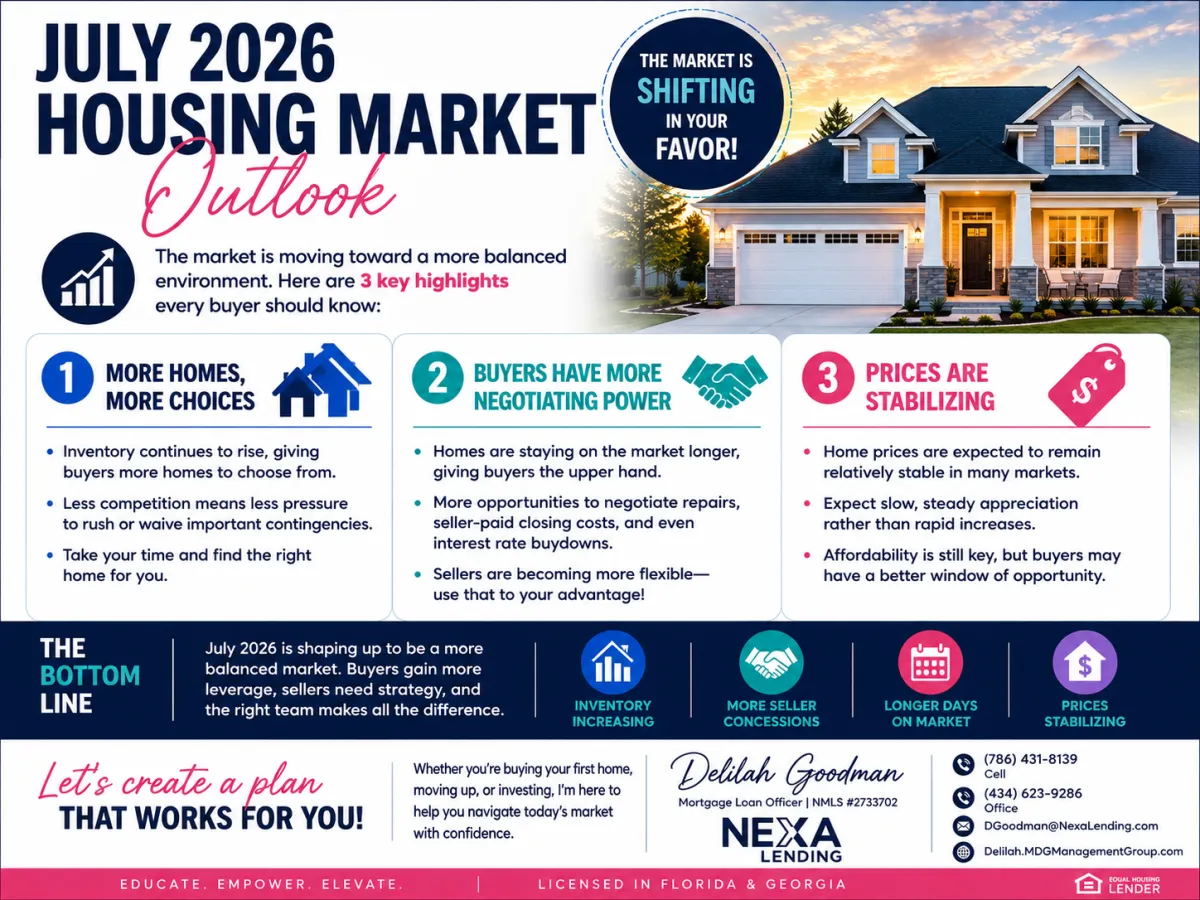
1. Inventory Will Continue Growing
Additional listings are expected to enter the market while buyer demand remains somewhat constrained by affordability.
This means buyers should continue seeing:
More choices
Greater flexibility
Less competition
Increased negotiating opportunities
2. Home Prices Should Remain Relatively Stable
Despite slowing activity, most forecasts continue projecting relatively stable home prices nationally.
Rather than significant nationwide declines, experts generally anticipate:
Flat pricing in many areas
Modest appreciation nationally
Localized price adjustments in markets with abundant inventory
Real estate remains highly local.
Conditions in one city—or even one neighborhood—may differ substantially from another.
3. Sellers May Need to Become More Competitive
Today's sellers can still achieve excellent outcomes, but pricing strategy matters more than ever.
Homes that are:
Properly priced
Professionally marketed
Well maintained
Move-in ready
are continuing to attract buyers.
However, overpriced listings may experience longer marketing times and require price adjustments before selling.
4. Builder Incentives May Become Even More Valuable
Many builders still need to move inventory.
Instead of dramatically lowering prices, they're expected to continue offering incentives such as:
Temporary interest-rate buydowns
Seller-paid closing costs
Appliance packages
Upgrade credits
Design-center allowances
These incentives can significantly reduce a buyer's upfront expenses and monthly housing costs.
5. Regional Markets Will Continue Performing Differently
One of the most important housing trends of 2026 is the growing divergence between local markets.
Areas with limited inventory and strong employment may continue seeing stable prices and healthy demand.
Meanwhile, markets with significant new construction or rapidly expanding inventory—such as portions of Florida, Texas, and parts of the Mountain West—may experience increased price reductions and larger seller concessions.
This makes local market expertise more valuable than ever.
What This Means for Homebuyers
Although affordability remains challenging, today's market offers opportunities that simply weren't available a few years ago.
Buyers may benefit from:
Greater negotiating leverage
Fewer bidding wars
Increased seller flexibility
More repair negotiations
Better financing opportunities through builder incentives
More time to make thoughtful decisions
The key is entering the market with a solid financial plan and a strong mortgage strategy.
What This Means for Sellers
Selling remains possible—but expectations should adjust to current conditions.
Successful sellers today are:
Pricing competitively from the beginning
Preparing homes for maximum appeal
Remaining flexible during negotiations
Understanding that buyers have more options than they did several years ago
The best-positioned sellers recognize today's market is about strategy—not simply listing a home and waiting for multiple offers.
What This Means for Realtors
For Realtors, today's environment places even greater emphasis on expertise.
Clients are asking more questions, taking longer to make decisions, and expecting guidance throughout the entire transaction.
Strong collaboration between Realtors and knowledgeable lending professionals can help buyers understand:
Monthly affordability
Financing options
Builder incentives
Negotiation opportunities
Closing cost strategies
Long-term financial planning
This creates smoother transactions and more confident clients.
What This Means for Mortgage Professionals
For mortgage professionals, 2026 is becoming less about simply securing financing and more about serving as trusted advisors.
Success increasingly comes from helping borrowers understand:
Loan program options
Affordability strategies
Down payment assistance
Rate buydowns
Builder financing incentives
Long-term payment planning
Education has become one of the most valuable services a loan officer can provide.
Final Thoughts
The housing market isn't returning to the fast-paced conditions of 2021, nor is it showing signs of a widespread nationwide collapse.
Instead, we're witnessing a healthy transition toward a more balanced market.
For buyers, that means more negotiating power and greater opportunity.
For sellers, it means pricing strategically and preparing homes to compete.
For Realtors and mortgage professionals, it means providing education, building trust, and helping clients navigate an evolving market with confidence.
No matter what headlines you see, real estate decisions should always be based on your individual financial goals, local market conditions, and a well-planned financing strategy—not fear or speculation.
If you're considering buying, selling, refinancing, or simply want to understand how today's market affects your goals, I'd be happy to help you create a strategy that's tailored to your unique situation.
About the Author
Delilah Goodman
Mortgage Loan Officer | NMLS #2733702
Licensed in Florida & Georgia
Whether you're a first-time homebuyer, repeat buyer, investor, or Realtor, I'm committed to helping you make informed mortgage decisions through education, transparency, and personalized financing solutions.
📞 Office: (434) 623-9286
📱 Cell: (786) 431-8139
📧 Email:[email protected]
🌐 Website:https://Delilah.MDGManagementGroup.com