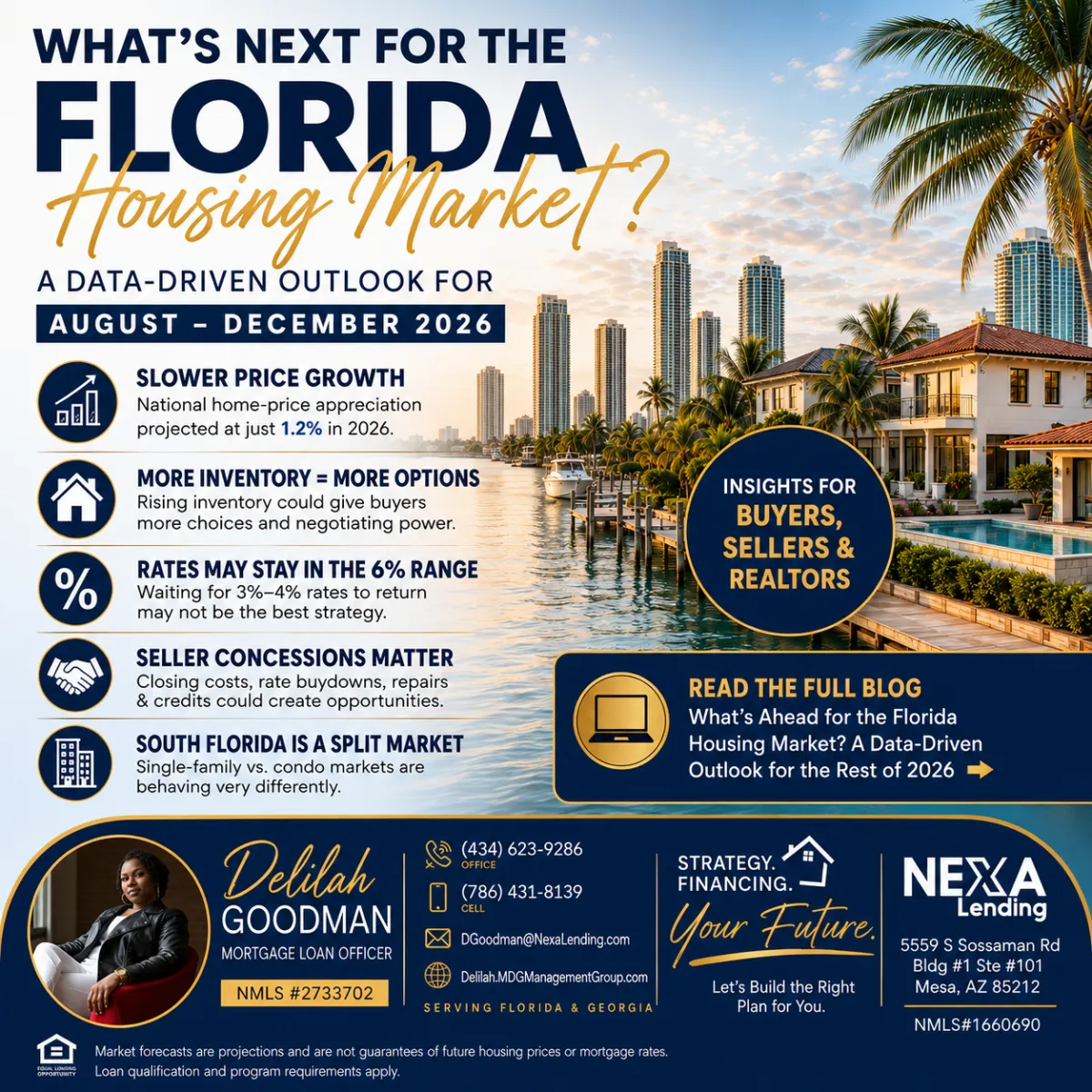
What’s Ahead for the Florida Housing Market?
What’s Ahead for the Florida Housing Market?
A Data-Driven Outlook for Buyers, Sellers & Realtors — August Through December 2026
If you've been waiting for the housing market to "make sense" again, you're not alone.
Mortgage rates remain elevated. Some homes are sitting longer. Buyers have more negotiating power in certain markets. Sellers are adjusting expectations. And here in Florida—particularly South Florida—the difference between the single-family and condominium markets has become increasingly important.
So what should buyers, homeowners, and real estate professionals expect as we move through the remainder of 2026?
The latest statistical data does not point toward one simple nationwide housing crash or sudden housing boom.
Instead, the evidence suggests we're moving into a more balanced and highly localized housing market, where affordability, property type, inventory, insurance costs, mortgage rates, and seller motivation will increasingly determine who has the negotiating advantage.
Let's look at what the numbers are telling us.
1. The National Housing Market Is Slowing—But Prices Haven't Collapsed
July 2026 existing-home sales declined 1.7% from June, reaching a seasonally adjusted annual rate of approximately 4.06 million homes.
However, sales were still approximately 0.7% higher than July 2025.
At the same time, the national median existing-home price increased approximately 2.0% year over year to $434,100.
That combination is important.
We're experiencing relatively weak transaction volume while home values nationally continue to show modest appreciation.
This does not resemble a traditional housing crash.
Instead, high borrowing costs are suppressing affordability and transaction activity while housing supply constraints continue supporting prices in many markets.
What this means for buyers
Today's buyer may have more negotiating power than they had several years ago—but affordability remains the primary challenge.
What this means for sellers
Homes can absolutely still sell, but pricing a property based solely on what neighboring homes sold for during a hotter market can be a costly mistake.
The market is becoming increasingly sensitive to:
Price
Condition
Location
Property type
Insurance costs
HOA expenses
Financing eligibility
Days on market
Source: National Association of Realtors data reported by Reuters, August 11, 2026.
2. Mortgage Rates Are Likely to Remain One of the Market's Biggest Variables
Anyone waiting for mortgage rates to immediately return to 3%, 4%, or even the low-5% range should be cautious about building a housing strategy around that assumption.
Realtor.com's July 2026 midyear housing forecast projects an average mortgage rate of approximately 6.3% for 2026, with rates also projected around 6.3% at year-end.
The same forecast expects approximately:
4.10 million existing-home sales in 2026
and only about:
1.2% national existing-home price appreciation.
That price forecast is particularly significant.
It suggests home prices may continue increasing nationally—but at a much slower pace than buyers became accustomed to during the pandemic housing boom.
Translation for buyers:
Waiting may not necessarily produce dramatically cheaper houses.
Translation for sellers:
You may still have appreciation, but you shouldn't automatically expect aggressive bidding wars or double-digit annual gains.
Translation for Realtors:
Financing strategy is becoming increasingly important to the sales conversation.
A buyer's decision may increasingly be based on:
"What will my monthly payment be?"
rather than:
"What's the purchase price?"
Source: Realtor.com 2026 Midyear Housing Market Forecast, July 8, 2026.
3. More Inventory Could Give Buyers Greater Negotiating Power
Realtor.com expects existing-home inventory to finish 2026 approximately 3.6% higher than the previous year.
That's an important development.
More inventory gives buyers choices.
And when buyers have choices, sellers have competition.
That doesn't automatically mean sellers will reduce prices dramatically.
Instead, we could see more transactions where buyers successfully negotiate:
Seller-paid closing costs
Mortgage-rate buydowns
Repair credits
Price reductions
Longer inspection periods
Contributions toward prepaid expenses
More favorable contract terms
This creates an important strategic opportunity.
The best negotiation isn't always the lowest purchase price.
For example, suppose a seller is willing to give up several thousand dollars to make a transaction work.
A buyer might initially think:
"Reduce the purchase price."
But depending on the buyer's loan program, qualifications and long-term plans, applying some of that negotiating power toward allowable closing costs or an interest-rate buydown could potentially create a greater immediate financial benefit.
That decision should be evaluated transaction by transaction.
4. South Florida Isn't One Housing Market
This may be one of the most important concepts for buyers and Realtors to understand during the remainder of 2026.
When someone says:
"The Florida housing market is slowing."
My next question would be:
Which market?
A single-family home in Broward County does not necessarily behave like a Miami-Dade condominium.
A luxury property in Palm Beach doesn't necessarily behave like a $350,000 first-time buyer property.
And a newly constructed home with builder incentives isn't competing under exactly the same conditions as a resale property.
This is why broad national headlines can sometimes be misleading.
Housing markets need to be evaluated locally—and increasingly by property type and price bracket.
5. South Florida's Condo Market Deserves Special Attention
One of the clearest examples is the condominium market.
Recent Miami-Dade condo data illustrates just how much inventory can change the buyer/seller relationship.
One July 2026 MLS-based analysis reported approximately:
$400,000 median closing price
18.3 months of condominium inventory
145 median days on market
and approximately:
95.2% sale-to-list ratio.
That is a dramatically different environment from a market where inventory is extremely limited.
More inventory means buyers can compare competing units.
And that gives buyers greater ability to evaluate:
HOA fees
Association reserves
Special assessments
Building condition
Insurance
Inspection history
Amenities
Financing eligibility
Comparable sales
Seller motivation
Realtors should pay particular attention here.
A condo may look affordable based on the purchase price while becoming substantially less affordable after incorporating:
Principal + Interest + Property Taxes + Insurance + HOA + Assessments
That complete monthly housing obligation matters.
And for financed transactions, the condominium project itself may also need to satisfy applicable lender and investor requirements.
6. Florida Condo Buyers Should Look Beyond the Unit
Condominium buyers increasingly need to evaluate two purchases:
The individual unit
AND
The financial and physical health of the association/building.
Florida's post-Surfside regulatory environment has increased attention on structural inspections, reserve requirements and future ownership costs.
Recent academic research analyzing more than one million Florida condominium transactions from 2020–2024 found evidence that markets capitalized both structural-risk information following Surfside and subsequent regulatory/reserve requirements into condominium pricing.
In plain English:
Buyers increasingly care about what owning that condo could cost them after closing.
That's why association documentation matters so much.
Before becoming emotionally committed to a condo, buyers and their Realtors should understand issues such as:
HOA budget
Reserve funding
Special assessments
Pending litigation
Building insurance
Milestone inspections
Structural Integrity Reserve Studies
Delinquencies
Owner occupancy
Financing eligibility
The cheapest condo isn't necessarily the least expensive condo to own.
7. Broward County Could Continue Showing a Split Market
Broward is another good example of why property type matters.
Recent market data has shown significantly tighter inventory for single-family properties than condominiums.
That creates two very different negotiating environments within the same county.
A properly priced single-family home in a desirable Broward neighborhood may still receive strong buyer attention.
Meanwhile, a condo seller competing against numerous similar units may need to offer considerably more favorable pricing or concessions.
For buyers:
Don't assume every Broward property automatically gives you negotiating leverage.
For sellers:
Don't assume the strength of nearby single-family sales automatically applies to your condo.
For Realtors:
Analyze months of supply by property type and price range, not simply countywide statistics.
8. Palm Beach County Can Also Vary Dramatically by Location and Price Point
Palm Beach County presents another example of market segmentation.
Certain communities continue experiencing strong demand and limited inventory while other segments are becoming more negotiable.
Luxury properties, entry-level properties, condominiums and suburban single-family homes can behave very differently.
That means buyers should avoid making offers based solely on headlines like:
"It's a buyer's market."
A better question is:
How much inventory exists for this specific type of property, in this price range, within this specific area?
That's where the real negotiating information is found.
9. Fall and Winter 2026 Could Create Opportunities for Prepared Buyers
Housing is seasonal.
Traditionally, transaction activity begins slowing as the market moves from summer into fall and winter.
Research published in 2026 also found evidence that the U.S. housing market's seasonal peak has shifted somewhat earlier toward spring in recent years.
That potentially makes the period from approximately September through December particularly interesting for prepared buyers.
Imagine a property that:
Didn't sell during summer
Has accumulated significant days on market
Has already experienced one price reduction
Is owned by a seller who needs to relocate
Has fewer buyers viewing it
Is competing against newer inventory
That seller may become significantly more receptive to negotiation.
And that's why buyers shouldn't necessarily evaluate market opportunities based solely on mortgage rates.
Sometimes seller motivation can be just as valuable as rate movement.
10. What Happens If Mortgage Rates Fall?
This is where housing becomes particularly interesting.
Many potential buyers are currently sitting on the sidelines waiting for rates to decline.
But consider what happens if mortgage rates meaningfully improve.
A lower rate does two things simultaneously:
It improves affordability.
But it can also:
Increase buyer competition.
People who couldn't qualify before may qualify.
Buyers who disliked their previous payment may return.
Investors may become more active.
Existing buyers may increase their price range.
Homes can begin selling faster.
Seller concessions can decrease.
So buyers shouldn't automatically assume:
Lower rate = better overall buying environment.
You could potentially receive a lower interest rate while simultaneously losing some of your negotiating leverage.
11. The "Buy Now and Refinance Later" Strategy Needs One Important Disclaimer
You'll sometimes hear:
"Marry the house and date the rate."
That can oversimplify the decision.
Refinancing later is never guaranteed.
Future rates aren't guaranteed.
Future property values aren't guaranteed.
Qualification isn't guaranteed.
Employment, income, credit, debt and property eligibility can all change.
Therefore, buyers should qualify based on a payment they can reasonably afford today.
If refinancing becomes financially beneficial later, that can be evaluated when the opportunity actually exists.
Don't purchase a home today that only makes financial sense if an uncertain refinance happens tomorrow.
12. First-Time Buyers Are Still Facing Significant Affordability Challenges
First-time buyers represented only approximately 29% of existing-home transactions in July 2026, according to recently reported national data.
That remains well below historical norms.
The challenge isn't necessarily lack of interest in homeownership.
It's affordability.
A modern housing payment may include:
**Principal
Interest
Property Taxes
Homeowners Insurance
Mortgage Insurance
HOA/Condo Fees
Flood Insurance, when applicable**
That's why education before shopping is so important.
A $400,000 property with a high HOA and expensive insurance could potentially carry a higher total monthly obligation than another property with a somewhat higher purchase price but lower recurring expenses.
Price does not equal payment.
13. Sellers Need to Adjust to the New Market
For sellers, the next several months could require a change in strategy.
The days of simply listing a property at an aggressive price and expecting multiple offers may not apply to every market.
Buyers now have access to more information.
They are comparing:
Price
Interest rates
Taxes
Insurance
HOA expenses
Builder incentives
Competing resale properties
Seller concessions
An overpriced home can quickly become stale.
And once buyers begin asking:
"Why has this property been sitting for 75 days?"
the seller's negotiating position may weaken.
Correct pricing from the beginning may become increasingly important.
14. Realtors: Financing Strategy Is Becoming a Competitive Advantage
This environment creates an opportunity for Realtors who collaborate closely with their lending partners.
Instead of only asking:
"How much can the buyer qualify for?"
consider asking:
"How can we structure this transaction intelligently?"
That could include evaluating:
FHA vs. Conventional vs. VA financing
Down-payment assistance
Seller contributions
Temporary buydowns
Permanent rate buydowns
Closing-cost strategies
Builder incentives
Condo eligibility
Cash-to-close
Debt-to-income ratios
Property taxes
Insurance
HOA expenses
The Realtor negotiates the real estate.
The lender structures the financing.
When those two strategies work together, the buyer can make a much more informed decision.
My Prediction for August–December 2026
Based on current statistical trends, I expect the remainder of 2026 to look more like normalization than collapse.
My base-case outlook:
Mortgage rates:
Likely remain volatile and generally within the 6% range rather than suddenly returning to pandemic-era levels.
National home prices:
Likely remain relatively stable with modest appreciation overall, while some local markets and property types experience declines.
South Florida condos:
Likely remain considerably more negotiable in markets with elevated inventory and high carrying costs.
South Florida single-family homes:
Likely remain stronger in neighborhoods where inventory is limited.
Seller concessions:
Likely remain an important negotiating tool.
Days on market:
Could increase as seasonal activity slows.
Price reductions:
Could become more common among properties initially listed too aggressively.
Buyers:
Should have greater negotiating opportunities—but affordability will remain a challenge.
Sellers:
Will need increasingly realistic pricing and property-specific strategies.
Realtors:
Will benefit from understanding financing as deeply as market statistics.
The Bottom Line
If you're waiting for someone to announce that it's officially the "perfect time" to buy a home, that announcement probably isn't coming.
Housing decisions are personal.
The better question isn't:
"Is now a good time to buy?"
It's:
"Do today's numbers make sense for me?"
For some buyers, waiting may absolutely be the right financial decision.
For others, the combination of increased inventory, seller concessions, reduced competition and negotiating opportunities could make the remainder of 2026 worth exploring.
The key is understanding the entire transaction—not simply the interest rate or purchase price.
Before shopping, understand your:
Budget. Payment. Cash-to-close. Loan options. Property expenses. Negotiating position.
Then make the decision based on numbers rather than headlines.
Let's Build Your Home Financing Strategy
If you're considering buying a home in Florida or Georgia—or you're a Realtor helping clients navigate this changing market—I'd be happy to help you evaluate the financing side of the transaction.
Let's look at the numbers before you make the offer.
Delilah Goodman
Mortgage Loan Officer | NMLS #2733702
Serving Florida & Georgia
Office: (434) 623-9286
Cell: (786) 431-8139
Email: [email protected]
Website: Delilah.MDGManagementGroup.com
Market forecasts are projections, not guarantees. Mortgage rates, property values, insurance costs, taxes, loan eligibility and local market conditions can change. Loan qualification and program requirements apply.